Your Personality's Fatal Flaw (And How to Fix It)
Your Personality's Fatal Flaw (And How to Fix It)
![[HERO] Your Personality's Fatal Flaw (And How to Fix It)](https://cdn.marblism.com/YVqMqbGlBXJ.webp)
Here's something that's going to sound harsh: the personality trait that makes you excellent at your job might be exactly what kills you.
Not "might make you less safe." Not "could increase your recordable injury rate." I mean it literally could kill you.
And here's the really uncomfortable part: it has almost nothing to do with whether you follow procedures or wear your PPE. You could be the most compliant worker in your facility, passing every safety audit, checking every box, and still be at elevated risk for a fatality.
Let me explain why.
The Injury That Never Happens
For decades, we've operated under a beautiful, simple, completely wrong assumption: that preventing small injuries would automatically prevent big ones. You know the pyramid, near-misses at the bottom, minor injuries in the middle, fatalities at the top. The logic was elegant: reduce the base, shrink the apex.
Except it doesn't work that way.
The Campbell Institute spent years studying this across multiple organizations, and here's what they found: 90.5% of serious injury and fatality events are associated with specific high-energy hazards that are categorically different from the hazards that cause minor injuries.
A worker who trips on a cluttered walkway and a worker who falls forty feet from a scaffold are not experiencing different severities of the same event. They're experiencing fundamentally different events. Different energy sources. Different failure modes. Different causal pathways.
You can eliminate every trip hazard in your facility and it won't save anyone from a fall from height. You can reduce hand injuries to zero and it won't prevent anyone from being caught in rotating equipment.
The hazards that kill people are different. And the psychological factors that lead to those deaths? Also different.

When Your Strength Becomes Your Vulnerability
This is where personality comes in, and where things get uncomfortable.
Each of the 12 Safety Archetypes has a characteristic pattern of vulnerability to serious injuries and fatalities. But here's what's wild: these SIF vulnerabilities often have nothing to do with their general safety risk profile. In fact, sometimes they're the inverse.
Take the Achiever. High achievers are typically excellent at general safety compliance. They're conscientious, they follow procedures, they maintain their equipment. If you're measuring recordable injury rates, Achievers look great. Low risk across the board.
But when it comes to fatalities? Elevated risk.
Why? Goal fixation under production pressure.
Let me paint you a picture. There's a maintenance window that's already been delayed twice. Production is screaming. Your Achiever knows exactly what needs to happen, they've done it a hundred times, and they're good at it. They can get this done.
So when they're up on that aerial lift and they realize the tool they need is just out of reach, maybe three feet to the left, not worth coming all the way down for, they lean. Just a little. Because they can see the finish line. Because stopping now means another delay. Because they've gotten away with it before.
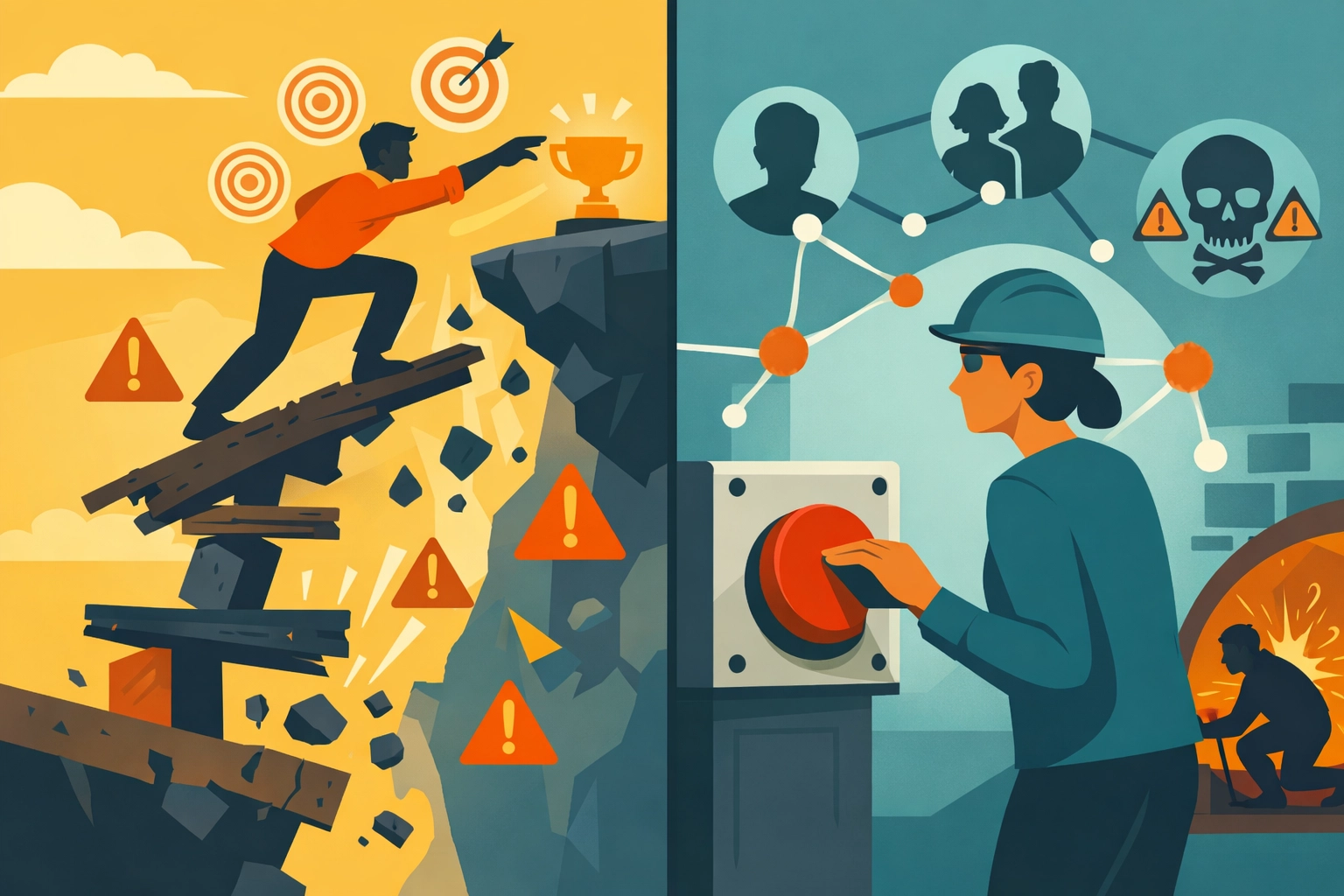
That goal fixation, that laser focus on completing the task, creates a psychological blind spot. In that moment, the Achiever's brain literally deprioritizes hazard recognition. The goal becomes so vivid that the gravitational potential energy surrounding them becomes invisible.
The thing that makes them excellent at execution becomes the thing that kills them.
The Fatal Cost of Being Nice
Now let's talk about the Harmonizer: the person everyone loves working with. Collaborative, supportive, maintains group cohesion. They're not risk-takers. They don't cut corners. Their general safety risk is moderate, maybe even below average.
But their SIF vulnerability? Elevated.
The killer isn't what they do. It's what they don't do.
Imagine this: A Harmonizer is working near a confined space entry. They notice their coworker skipped the atmospheric testing: rushed it, maybe, or forgot the calibration, or just didn't wait long enough for the monitor to stabilize. The Harmonizer knows it's wrong. They know they should say something.
But they also know their coworker is already stressed. The supervisor is already in a bad mood. Saying something will create tension. Will make them look like they're not a team player. Will make their coworker defensive.
So they don't. They rationalize: "He's probably done this a thousand times. He knows what he's doing. I don't want to undermine him."
That conflict avoidance: that drive to maintain harmony: creates a blind spot around exercising stop-work authority. The Harmonizer sees the hazard. They recognize the risk. But the psychological cost of creating interpersonal tension outweighs their ability to act.
And then their coworker dies from hydrogen sulfide exposure.
The thing that makes Harmonizers essential for team function becomes the thing that prevents them from saving a life.
Your Psychological Blind Spot
Here's what's happening in both cases: the same personality trait that produces positive outcomes in most situations creates a specific, predictable blind spot in high-energy hazard scenarios.
These aren't random failures. They're not "human error" in any useful sense. They're systematic vulnerabilities linked to how different archetypes process risk under specific conditions.
And it's not just Achievers and Harmonizers:
The Adventurer's comfort with uncertainty becomes dangerous near struck-by hazards. Their intuitive risk tolerance, which usually serves them well, can lead to underestimating kinetic energy risks from mobile equipment or falling objects.
The Analyst's need for complete information can delay action during energy isolation failures. While they're gathering data to understand the full scope of the problem, stored hydraulic or electrical energy is released.
The Enforcer's rigid adherence to rules can create blind spots around situational awareness. They're so focused on whether procedures are being followed that they miss changing conditions that make those procedures insufficient.
The Skeptic's distrust of warnings can lead them to discount confined space atmospheric monitoring results or chemical exposure limits: "those sensors are always oversensitive."
Different archetypes. Different SIF vulnerabilities. Same outcome if left unaddressed.
The Goal Isn't to Change Who You Are
Let me be really clear about something: we're not trying to turn Achievers into Harmonizers or Adventurers into Analysts. That's not the point, and it wouldn't work anyway.
Your personality is part of what makes you good at what you do. The Achiever's drive is valuable. The Harmonizer's social awareness is essential. The Adventurer's adaptability matters.
The goal is awareness.
Because when you understand your own psychological blind spot: when you can name it, recognize it, see it coming: you can compensate for it.
The Achiever who knows they're vulnerable to goal fixation under pressure can build in forcing functions: "Before I do anything unusual to reach a goal, I'm going to call someone and explain what I'm about to do out loud." That external verbalization interrupts the fixation.
The Harmonizer who knows they struggle with stop-work authority can pre-commit to scripts: "I have a specific set of phrases I use when I need to stop work that minimize interpersonal tension while still being clear." They've practiced them. They're ready.
The Adventurer vulnerable to struck-by hazards can implement personal rules: "I always position myself with my back to a solid structure in vehicle operating areas, no exceptions." They're not changing their personality; they're creating a mechanical barrier between their intuitive risk tolerance and kinetic energy.

Building Awareness, Not Guilt
This isn't about blame. It's not about making people feel bad for having the personality they have.
It's about precision.
For too long, we've talked about "human factors" in safety as if all humans were the same. As if the psychological factors that make one person vulnerable were the same as everyone else's. As if we could design one-size-fits-all interventions and expect them to work equally well for twelve fundamentally different personality patterns.
That's why traditional behavior-based safety programs plateau. That's why your TRIR improves but your fatal risk doesn't move. You've been treating symptoms of general safety risk while the causes of SIF risk operate in a completely different domain.
When you understand that the Achiever and the Harmonizer need fundamentally different interventions: that the hazards they're vulnerable to and the psychological mechanisms that create that vulnerability are different: you can actually design prevention that works.
Not safety theater. Not more reminders to "stay focused" or "speak up." Actual, targeted, archetype-specific awareness and intervention protocols.
What This Looks Like in Practice
In PERSONA SIF training, we help workers identify their own archetype first. Then we walk through their specific SIF vulnerability pattern: not in abstract terms, but connected to the actual high-energy hazards present in their work environment.
"You're an Achiever working in a facility with fall-from-height exposure, vehicle-pedestrian interfaces, and energy isolation procedures during maintenance. Here's what goal fixation under pressure looks like in each of those contexts. Here's how to recognize it. Here's what to do instead."
"You're a Harmonizer in the same facility. Here's what conflict avoidance looks like when you witness a coworker bypassing fall protection, entering the vehicle path without a spotter, or starting work without verifying lockout. Here's how to exercise stop-work authority in a way that maintains relationship while still being effective."
Specific. Practical. Personalized.
Because everyone has the right to feel and be safe.


Comments
Post a Comment